

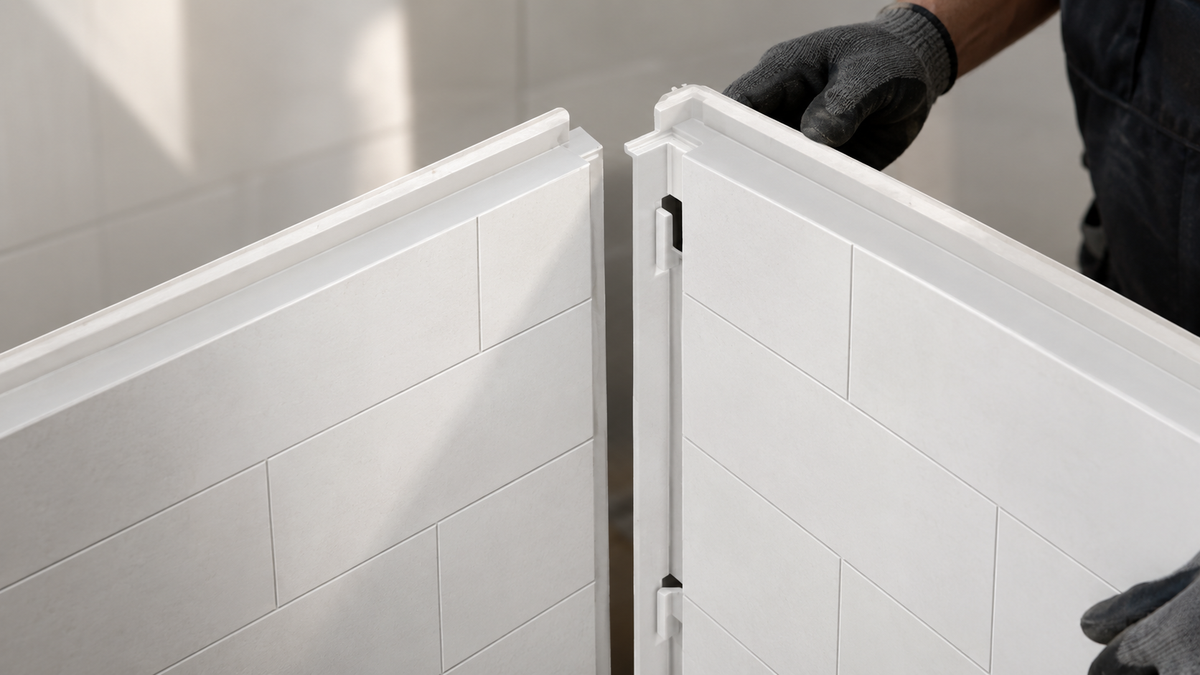
In bathroom products, wall panels and other components need to work together as a complete system. How they fit, align, and lock together can directly influence installation, waterproofing, and long-term performance.
This is why modern bathroom design is paying more attention to engineered connection systems.
One connection concept, although rooted in traditional woodworking, offers an interesting perspective for modern bathroom design: the mortise and tenon joint.
By using precisely matched protrusions and recesses, mortise and tenon construction creates a mechanical connection between components. Modern bathroom wall panels may use a different form of connection, but interlocking systems follow a similar design principle: precise fitting, structural engagement, and making the connection part of the product itself.
So, how does the mortise and tenon principle work? What are its key advantages? How does it compare with screws and adhesive connections? And more importantly, how can this connection philosophy be applied to modern SMC bathroom wall panels and complete bathroom systems?
Let’s start with the basics.
1. What Is a Mortise and Tenon Joint?
A mortise and tenon joint is a traditional connection method that uses a protruding section and a corresponding recess to join two components.
The two parts are:
-
Tenon: The projecting part of a component
-
Mortise: The corresponding opening or recess
During assembly, the tenon fits into the mortise, creating a mechanical connection between the two components.
Unlike connections that rely primarily on screws, nails, or adhesives, mortise and tenon construction makes the geometry of the components itself part of the connection.
In simple terms:
Instead of simply fastening two parts together, the parts are designed to engage with each other.
This structural approach is one of the fundamental ideas behind mortise and tenon construction.
2. How Does the Mortise and Tenon Principle Create Stability?
The stability of a mortise and tenon joint comes from several factors, with precision and structural fit at the center.
Precise Dimensional Matching
The mortise and tenon must be designed with carefully controlled dimensions.
The right fit allows the components to engage securely while maintaining proper assembly.
For this reason, precision is not simply an additional requirement of mortise and tenon construction. It is fundamental to how the connection works.
Multi-Directional Constraint
A well-designed joint can restrict movement in multiple directions.
Depending on its geometry, the connection can help limit lateral movement, longitudinal movement, and rotation, allowing the connected components to function more like a unified structure.
Effective Load Transfer
Rather than concentrating the connection at a single fastening point, a properly designed joint can use the contact surfaces between components to transfer and distribute forces.
This structural relationship contributes to the stability of the overall assembly.
3. What Are the Advantages of Mortise and Tenon Construction?
① Structural Connection
One of the defining characteristics of mortise and tenon construction is that the components themselves create the connection, reducing reliance on additional fastening elements.
② Stable Engagement
Precise dimensional matching creates a mechanical engagement between the components, helping establish a secure connection.
③ Clean Appearance
Because the connection can be integrated into the components, visible fasteners can be minimized, creating a cleaner overall appearance.
④ Design Flexibility
Mortise and tenon is not limited to one specific shape or configuration.
The geometry can be adapted according to the material, dimensions, structural requirements, and intended application.
⑤ Precision-Driven Design
The effectiveness of this type of connection depends heavily on accurate design and manufacturing.
This makes the concept highly relevant to modern manufacturing, where standardized designs and controlled production processes allow engineered connections to be reproduced consistently.
4. How Does It Compare With Other Connection Methods?
Modern manufacturing and construction use a variety of connection methods, including mechanical fasteners, adhesives, and interlocking systems.
Each approach has its own characteristics.
| Comparison | Mortise / Interlocking Connection | Screw Connection | Adhesive Connection |
|---|---|---|---|
| Core principle | Structural engagement | Mechanical fastening | Material bonding |
| Connection method | Components fit together | Fasteners secure components | Adhesive bonds surfaces |
| Additional fasteners | Can be minimized | Required | Adhesive required |
| Appearance | Can be concealed | Fasteners may be visible | Generally clean |
| Precision requirement | Relatively high | Moderate | Depends on application and installation |
| Standardized application | Well suited to engineered designs | Widely applicable | Widely applicable |
| Disassembly | Depends on the design | Generally easier | Usually more difficult |
There is no single connection method that is ideal for every application.
The right solution depends on factors such as material properties, environmental conditions, structural requirements, and installation methods.
For bathrooms, where products operate in a moisture-rich environment and projects often place strong demands on installation efficiency and long-term performance, connection design becomes particularly important.
5. From Traditional Joinery to Modern Bathroom Systems
The form of mortise and tenon construction has evolved, but its underlying design principles remain relevant.
Modern engineering does not need to replicate traditional wooden joinery exactly. Instead, it can apply the same fundamental ideas of precise fitting, structural interlocking, and reducing unnecessary connection components to modern materials and manufacturing processes.
For bathroom wall panels, this means the connection can be considered during the product design stage itself.
Rather than treating each wall panel as an independent piece of material, an engineered connection system allows adjacent panels to work together through a predefined structure.
This can create a clearer installation logic while reducing the complexity associated with conventional wall-panel connections.
In this sense, modern interlocking wall panels and traditional mortise and tenon joints may use completely different materials and structures, but they share a similar design philosophy:
Make the connection part of the product—not simply an extra step during installation.
6. Kostone Bathroom Systems: Bringing Interlocking Design to Modern SMC Products
Based on this design philosophy, Kostone bathroom systems use an interlocking connection design, allowing wall panels to engage with one another through precisely engineered connections.
Unlike traditional wooden mortise and tenon construction, Kostone systems are manufactured using SMC (Sheet Molding Compound), a composite material designed for demanding applications.
SMC offers properties that make it well suited to bathroom environments, including water resistance, wear resistance, durability, and resistance to moisture-related challenges.
Combined with an engineered interlocking system, Kostone bathroom products offer several advantages:
Fewer Complicated Joints
The interlocking structure allows wall panels to connect through a predefined system, helping reduce the complexity associated with conventional wall-panel joints.
Engineered Water-Resistant Design
The interlocking structure works together with the overall product design to support a more water-resistant bathroom wall system.
Moisture and Mold Resistance
SMC is well suited to high-moisture bathroom environments and helps address common challenges associated with prolonged exposure to moisture.
Durable Surface Performance
SMC provides good wear resistance and durability, making it suitable for bathrooms in residential, hospitality, and multi-family applications.
Standardized Installation
The connection structure is integrated into the product during the design and manufacturing process, creating a more straightforward and repeatable installation approach.
Designed for Project Applications
For Multi-Family, Hospitality, Healthcare, and residential construction projects, standardized bathroom wall panels and shower bases can support more efficient and consistent project execution.
The principle is simple:
Better connection design can create a better bathroom system.
From traditional mortise and tenon construction to modern interlocking bathroom wall panels, the materials and manufacturing technologies may be different, but the underlying idea remains the same:
Use intelligent structural design to make components work together.
Looking for an Engineered Bathroom System?
If you are looking for bathroom wall panels and shower bases for North American residential, Multi-Family, hospitality, healthcare, or other construction projects, explore what Kostone has to offer.
From SMC composite materials and interlocking connections to engineered bathroom systems, Kostone is committed to providing durable, efficient, and project-ready bathroom solutions.
Discover how Kostone can simplify bathroom construction for your next project.
👉 Explore our bathroom systems and contact our team for product information and project inquiries.
Share:
From Product Quality to Delivery: What Defines a Reliable Bathroom Supplier?